Projects
Fantasy IDL
February 2026
Overview
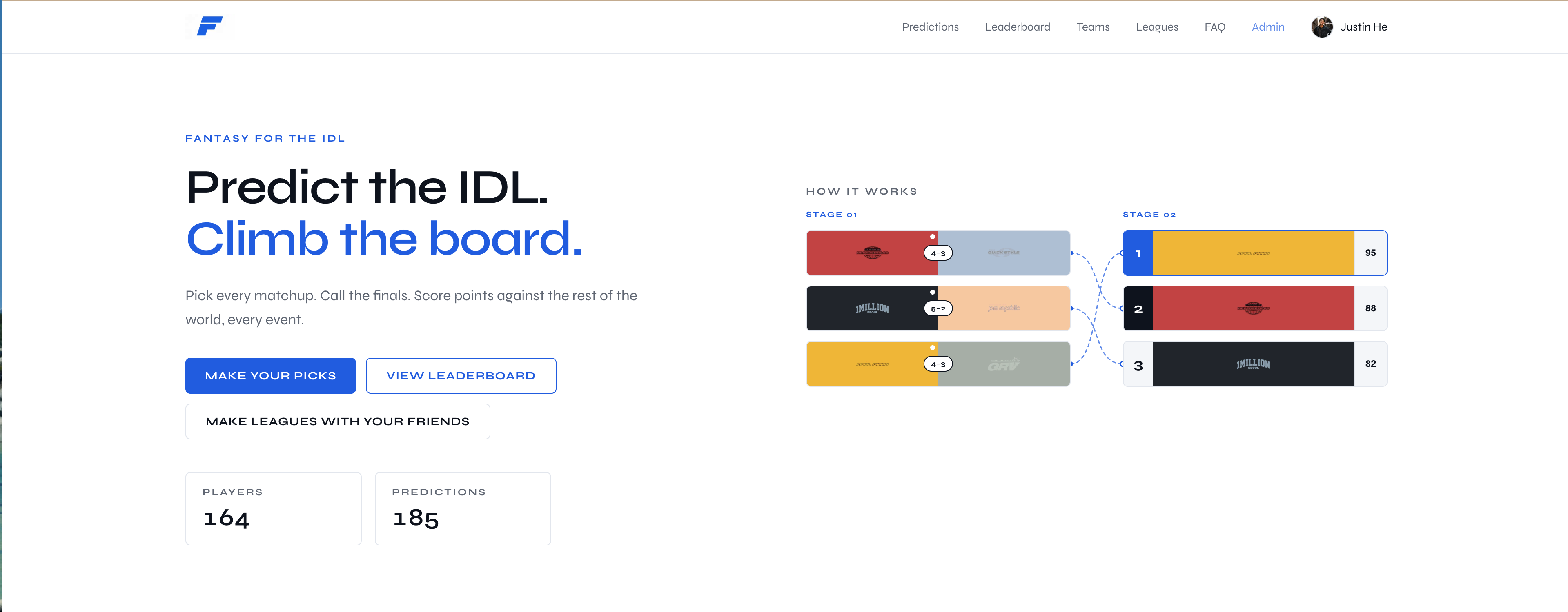
Fantasy IDL is a prediction game for a live dance-crew competition. Six real crews — Brotherhood (Vancouver), Royal Family (Auckland), Jam Republic (Singapore), GRV (LA), 1MILLION (Seoul), and Quick Style (Oslo) — go head to head, and fans call the results before they happen.
Each event runs in two stages. In the first, crews battle 1v1 in front of a seven-judge panel, and you predict the vote split — a 5–2 that lands 6–1 still costs you. In the second, the survivors compete for the top three places with point scores, and you call who makes it and where they land.
You earn points two ways: for getting the winner or rank right, and for how close your margin was. Those scores feed per-event and all-time leaderboards, and you can start a private league to compare with friends. During an event, an admin enters judge results live from a control room while everyone watching sees the board move over SSE.
Architecture
Browser (Next.js) → a Next.js BFF on Vercel → FastAPI on Fly.io → Supabase Postgres.
The browser never calls the API directly. The Next.js layer reads the Supabase session from HTTP-only cookies on the server, attaches the JWT, and forwards the request — so the backend URL stays private and no token ever reaches client JavaScript. FastAPI checks those tokens against Supabase's JWKS, and a user's role lives in the app database rather than in the auth provider.
Most of what follows wasn't algorithmic. It was keeping a live-scored game honest and consistent while an admin types in results in real time.
One scoring path, reused everywhere
Scores show up in four places: the stored leaderboard cache, the live in-progress board, a player's own results page, and the "top scorer" badge on the events list. The moment one of those computes a score differently, someone sees two numbers for the same pick. So they all run through a single set of helpers, a test pins them together, and the internal score records carry their own matchup and team ids — nothing depends on two queries coming back in the same order.
You can't predict the past
Picks stay editable until lock, and results go in as battles finish, which leaves an obvious hole: predicting something that already happened. Every scoring path drops any prediction created after the result it's being measured against. That check sits in three different code paths, each with a comment reminding you to keep the other two in step.
Only one event runs at a time
The live experience assumes a single active event, so three things guard it. The app takes a row lock (SELECT … FOR UPDATE) before flipping status, a small state machine only allows upcoming → in-progress → completed, and a partial unique index in Postgres makes a second in-progress row impossible at the database level. When that index rejects a write, the error is caught and returned as a plain 400 instead of a stack trace.
Ranking with ties
Leaderboards get subtle once ties meet pagination. Ranks are worked out over the whole sorted field and then sliced in Python — not with SQL OFFSET/LIMIT — so a tie doesn't move depending on which page you're on, and they follow standard competition ranking (1, 1, 1, 4…). Reads are tiered: upcoming events skip scoring entirely, live events read the cache, and the fallback batch-loads in a few queries instead of one per user.
Finals that follow your picks
Which crews are eligible for finals depends on who you picked to win their matchups. Change a matchup and the old winner's finals row would hang around as a phantom fourth finalist — so after each bulk save the server recomputes the winners and deletes finals rows for crews you no longer have advancing. Rank is recalculated from the points you entered; the client's version is never trusted.
The live board
Updates ride on Server-Sent Events. One manager maps each event to its set of subscriber queues, and those queues are capped and drop frames for slow clients so a single stalled tab can't run memory away. The BFF relays the upstream stream through a ReadableStream with a hard 30-minute cutoff to avoid leaking connections, and the browser reconnects with backoff.
None of this is hard on its own. Put it under a live event with people watching and "simple" turns into making every number agree, closing the door on hindsight picks, and holding the one-event rule through a race.